How to Plan a Software Investment Backed by an SME Grant

The news that "a grant call has opened" tends to trigger the same sequence in most companies: download the application form first, then start wondering what to buy. But support programmes finance an investment; they do not make the investment decision for you.
When the order gets reversed, the outcome is familiar: six months later the software is a tab nobody opens, while the grant report says "installed". This article lays out the right order — measure first, define scope second, apply last.
This article is for general information and is not financial or legal advice. The scope, conditions and deadlines of support programmes change. Before applying, rely on the current call text published by the agency and on your own financial adviser.
Which door is open right now?
In Türkiye, applications for the third 2026 period of KOSGEB's Capacity Development Support Programme opened on 22 August 2026 and close on 15 September 2026. The programme targets scale-up and digital transformation investments that strengthen the productivity, production capacity and organisational structure of small and medium-sized businesses.
The detail that matters here: eligible cost items include enterprise software spending that supports digital transformation, alongside machinery, equipment and tooling, personnel costs, service purchases such as training, consultancy, certification, marketing and design, and project-related working capital. Applicants must be registered, active and within the SME size definition.
The agency also runs a dedicated SME Digital Transformation Support Programme. Which door fits you depends less on the size of the investment than on its nature: software bought as part of a capacity expansion package points one way, a pure digitalisation project another.
In a wider frame, Türkiye's National AI Action Plan (2026-2030) entered into force through a Presidential Circular published in the Official Gazette on 18 August 2026. It includes headings such as AI vouchers for SMEs and access to compute resources; we covered it in the AI action plan and SME support. In short, several doors will be open for software and data investment in the coming period — the real question is not which one you walk through, but what you are holding when you walk out.
The one question to answer before applying
This one: which loss are we stopping?
Companies usually discuss investment in the language of "we need this". A grant file asks for a measure. The sentence that translates between the two goes like this: "Today we lose X hours / X units / X days a month; after this investment we expect that to be Y."
A few examples:
- Unplanned downtime on the shop floor is not recorded, so monthly downtime is discussed by guesswork.
- Stock count differences repeat every month and inventory records do not match reality.
- The monthly report takes two full days to assemble, and by the time it is ready the data is stale.
- The same record is keyed into three separate systems by hand; every entry is another chance for an error.
If you cannot build that sentence, the problem is not the application — it is the measurement. Software bought without knowing what it should improve is, at best, an expensive experiment. On picking the right measure, choosing the right KPIs is a good starting point.
Which software investment makes a solid project?
One with a measurable output. Four headings we see often, each with a clear metric:
Production visibility. Machine stoppages and their causes recorded, scrap rate visible per shift. Output metrics: unplanned downtime, scrap rate, lead time. We covered this in production monitoring and OEE.
Stock and inventory control. Smaller count differences, faster inventory turnover, fewer stockouts on critical materials — the measures in inventory management for SMEs.
Reporting and decision infrastructure. How long the monthly report takes, how late it arrives, how often the same question gets two different answers. On what belongs on the screen, see designing an effective dashboard.
Integration between systems. Manual data entry disappearing, the order-to-invoice cycle getting shorter. ERP, CRM and e-commerce integration describes the anatomy of that setup.
What the four share: each can be measured before and after the investment. That is exactly what makes a grant file strong.
Baseline: two weeks of measurement, months of usefulness
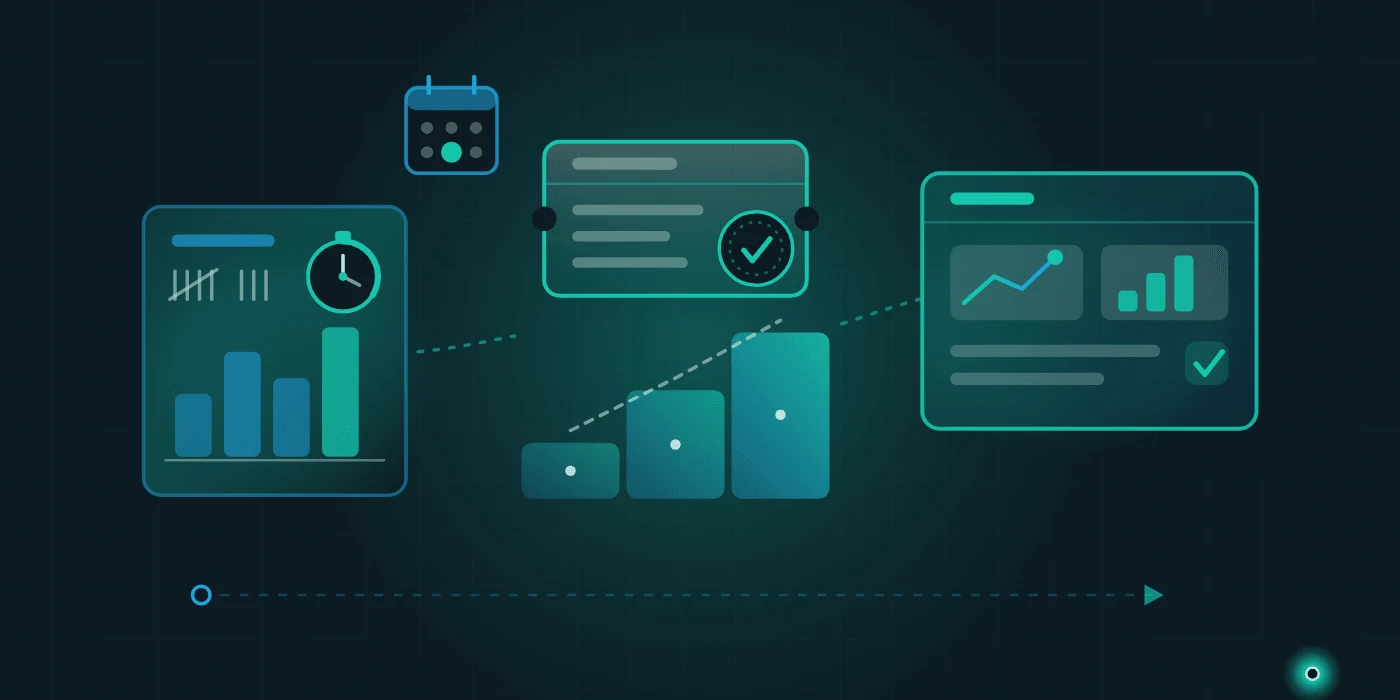
The weakest part of most application files is the "current situation" section, where an estimate gets written down. Even two weeks of simple measurement changes that:
- Pick the process you want to improve (one process).
- Record it for two weeks, by hand if necessary: how often, how long, how many errors.
- Put the records in a table and compute the average.
- Write the target on top of that number: "from 40 hours a month to 15."
This measurement is not only for the application. It is the only way you will later be able to say whether the investment worked. You cannot claim improvement in something you never measured. And if the record itself is poor, so is the conclusion — why data quality matters covers that trap.
How should you ask for a quotation?
The quotation that goes into a grant file should not read "software: one line item". A good one shows these separately:
- Scope: which screens, which reports, which integrations — and what is explicitly out of scope.
- Licence versus development: an off-the-shelf licence and custom development should never share a line.
- Setup, data migration and training: the items most often forgotten, and the ones that turn into surprises later.
- Maintenance and support: the annual commitment, worth knowing even if it falls outside the grant period.
- Timeline and definition of done: the meaning of the word "finished" should be written down.
We listed what to compare in before you request a software quote. For the packaged-versus-custom decision, see custom software or off-the-shelf.
What if the grant does not come through?
A project without an answer to that question is a wish, not a plan. The healthy approach is to split the investment into stages:
- Stage one: one process, one team, small scope. Small enough to fund yourself if needed.
- Stage two: expansion built on the measured result of stage one. If a grant arrives here, it accelerates.
That order does two jobs at once: if the grant does not come, work continues; if it does, you arrive with a measured result and a stronger file. For structuring the sequence, see a digital transformation roadmap for SMEs.
Three common mistakes
1. Inventing a need to match the programme. Reading the call text and asking "what can we buy that fits" skips the company's actual bottleneck. A grant exists to make a necessary investment cheaper, not to justify an unnecessary one.
2. One giant scope in a single step. Going live with production, stock, accounting and sales modules at once magnifies both the rollout risk and the team's resistance.
3. Forgetting training and data preparation. The software is installed, the data is not ready, and nobody was trained. Most failed investments fail in these two lines.
Conclusion: with the right order, a grant accelerates you
Support programmes are a genuine opportunity, but they are not a substitute for a strategy. The right order is: measure the loss you intend to stop, build the scope on top of it, and apply last. A company that moves in that order wins whether or not the grant comes through.
If you would like us to measure your current processes, work out which investment pays back fastest, and prepare the scope document and quotation with you, get in touch; to see how we work, take a look at our services.
Frequently Asked Questions
- When is the 2026 third-period application window for the Capacity Development Support Programme?
- Applications for the third 2026 period opened on 22 August 2026 and close on 15 September 2026. Applicants must be registered, active and within the SME size definition. Periods and conditions change, so rely on the agency's current call text before applying.
- Is software spending an eligible cost under these programmes?
- The Capacity Development Support Programme lists enterprise software spending that supports digital transformation among its eligible items, alongside machinery, personnel, training and consultancy. How each item must be documented varies by call, so check the current text and your financial adviser line by line.
- What preparation does a grant application need?
- The most valuable preparation is a baseline measurement: pick one process, record for two weeks how often it happens, how long it takes and how many errors occur, then set the target on top of that. The second is a quotation with a clear scope and definition of done, showing licence, development, data migration, training and maintenance as separate lines.
- For a grant file, is packaged software or custom development a better fit?
- What makes a file strong is the measurability of the outcome, not the type of product. For a standard process, a packaged product is fast and predictable; where a company-specific flow is your competitive edge, custom development earns its cost. A mix is common: a packaged core with custom integration and reporting. Choose whichever stops the measured loss fastest.
Need help with this topic?
Contact Us