AFK: Army For Keyboard — Heroes, Elements and Weekly Mutations
On this blog we usually talk about how data and software create value for businesses. Today, though, we're going behind the scenes to share a project we built ourselves: AFK: Army For Keyboard. True to its name, it's an idle RPG that lives right above your Windows taskbar and fights automatically while you get on with everything else. Your three-hero squad battles on its own in a thin strip at the bottom of the screen; your job is to set the strategy — who to field, which element to lead with, and how to adapt to conditions that change every week.
Written in pure JavaScript with no framework, the game turns on three tightly interlocking mechanics: heroes, elements and weekly mutations. Let's see how they come together.
An Army That Lives on Your Taskbar
AFK: Army For Keyboard is an "idle" role-playing game: your army fights automatically, collects loot and experience, and you spend what you earn leveling heroes, upgrading gear and pushing into harder stages. Because it's "AFK," progress continues while you're away from the computer — even while the game is closed. But automatic combat doesn't mean the game decides for you; the real game is the plan you set before the fighting starts.
Nine Heroes, Five Elements
You build your squad from nine heroes, each with a distinct role and an element. Three start unlocked and form a balanced core:
- Frostwarden (Cold) — an icy front-line tank; freezes and slows enemies and holds the line with heavy armor.
- Stormcaller (Lightning) — a ranged storm DPS; rains fast damage with bouncing chain lightning.
- Warlock (Fire) — a dark mage who stacks burns; deals damage over time and leeches health.
Six more heroes, unlocked with gold, add depth: Slayer (Physical berserker), Assassin (Chaos assassin — glass-cannon fragile but lethal on crits), Druid (Cold nature hybrid; poisons and heals the army), Necromancer (Chaos summoner; grows the army with skeletons), Paladin (Physical support-tank; buffs and shields the army) and Monk (Physical sustain DPS; stays alive through life-steal and dodge).
The crucial constraint: you can field only three heroes at once. So which elements and which roles (tank / DPS / healer) you combine is a genuine decision — and its best answer changes every week.
Elements: A Five-Way Cycle
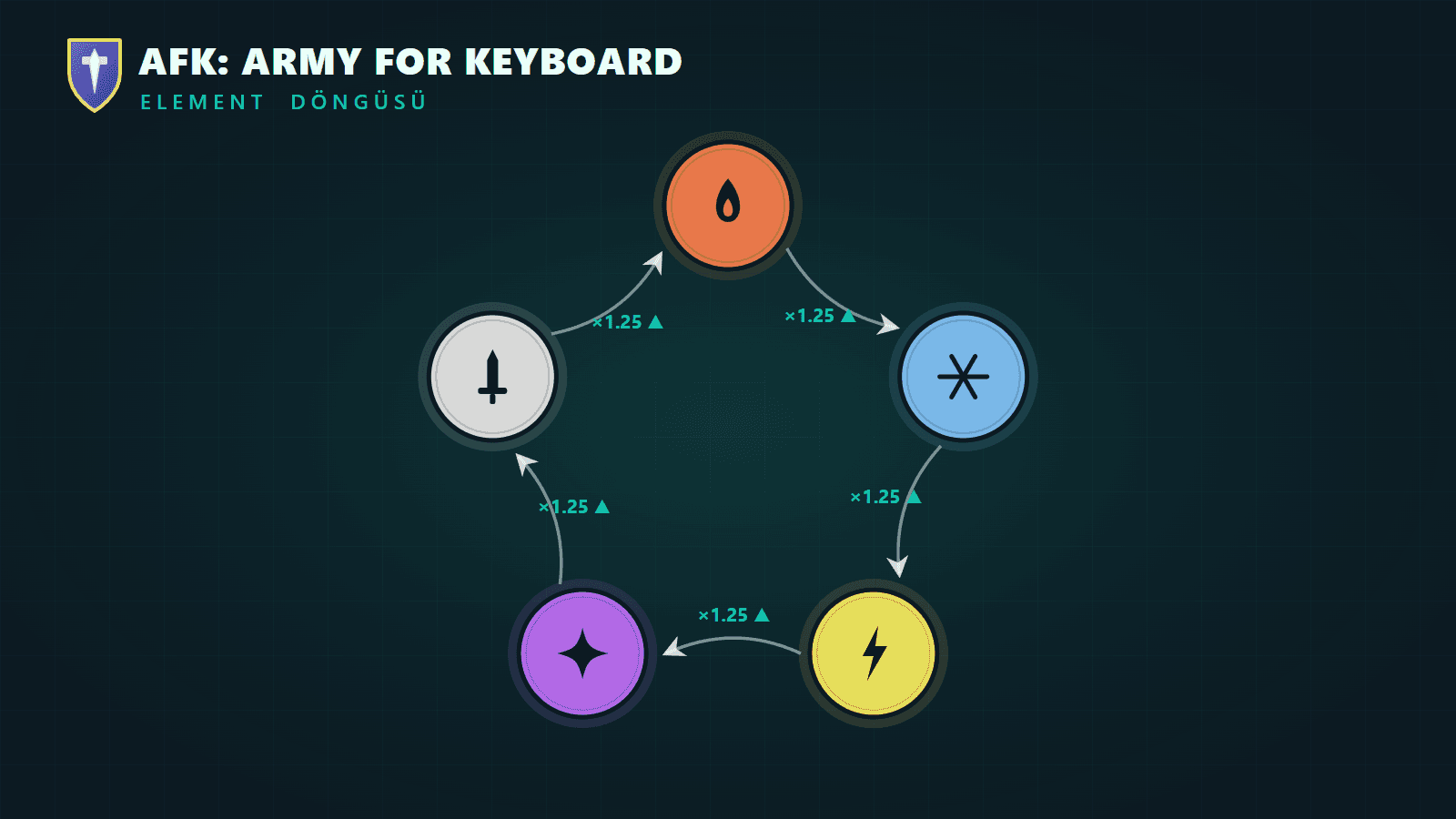
The five elements form a rock-paper-scissors ring: Fire → Cold → Lightning → Chaos → Physical → Fire. The arrow means "suppresses." An attack deals ×1.25 to the element it suppresses (an effective hit, shown with ▲), ×0.85 to the element that suppresses it (a resisted hit, ▼), and ×0.9 to its own element. The ring on the cover image shows exactly this relationship.
Most importantly, the rule works both ways. The element matchup is calculated when your hero hits a monster and when a monster hits your hero. So it isn't only about "hitting harder"; field the wrong element and the enemy hits you harder too. For example, the Fire-element Warlock melts Cold monsters (×1.25) but is weak to a Physical enemy (×0.85). Getting the matchup right can nearly double the impact of the very same squad.
Weekly Mutations: A Battle That Shifts Every Thursday
Here's the mechanic that keeps the game fresh week to week: the weekly mutation. Every Thursday at 00:00 UTC a single global modifier kicks in, and for that whole week everyone plays under the same condition — whatever your time zone, all players see the same mutation. Five mutations rotate in turn:
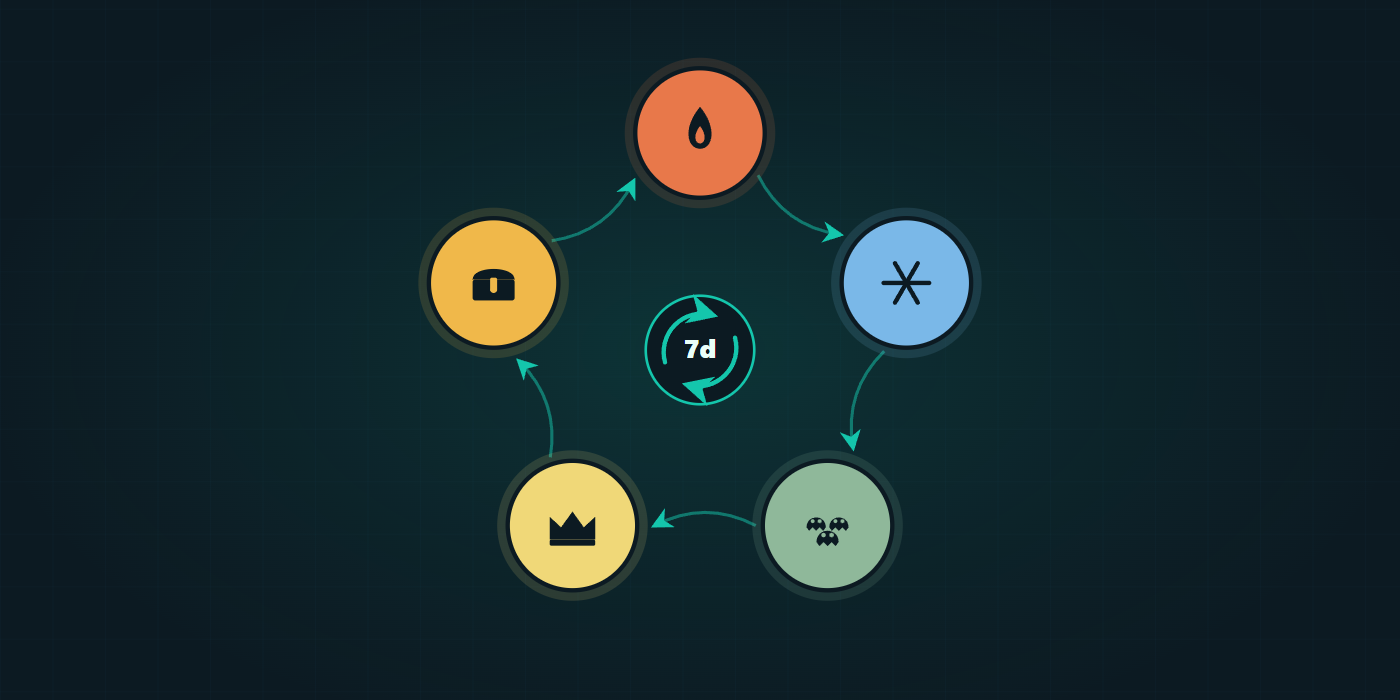
- Ember Week: Fire monsters gain +25% HP and attack; gold reward ×1.2.
- Frost Week: Cold monsters gain +25% HP and attack; chest chance ×1.25.
- Horde: +1 monster per wave (up to 6); XP ×1.15.
- Elite Uprising: Stage bosses gain +40% HP; chest chance ×1.5.
- Fortune Week: All monsters gain +15% HP; chest chance ×1.4.
Mutations affect only the single-player (PvE) side; competitive battles stay deterministic, with everyone running the same course from the same seed. That way the weekly surprise adds fun without touching fair competition.
Building Your Squad by Element
The real depth appears when you combine the mutation with the elements. The week's mutation practically dictates the squad you should build:
- Ember Week buffs fire monsters. Since Physical suppresses Fire, fielding physical hitters like Slayer, Paladin or Monk earns you the ×1.25 edge. On the flip side, because fire suppresses Cold, ice heroes like Frostwarden and Druid take extra damage that week — pull them to the back row or bench them.
- Frost Week is the mirror image: the Fire-element Warlock melts cold monsters; and since cold suppresses Lightning, it's wise not to field Stormcaller that week.
- Horde crowds the screen, so area damage (AoE) shines — Stormcaller's chain lightning, Slayer's spinning axe, the Necromancer's corpse explosion. And with the XP bonus, it's the best week to level up newly unlocked heroes.
- Elite Uprising inflates bosses; for long fights, single-target burst (the Assassin's death mark), a solid tank and a healer are the ideal trio. The raised chest chance makes it a fine week to farm gear, too.
- Fortune Week makes everything slightly tougher but lifts chest chance — it's the week to farm loot with your most trusted all-round squad.
In short, there's no fixed answer for the "strongest squad"; the right squad reshapes itself every Thursday. That's exactly what turns the game into a puzzle and the squad panel into a chessboard.
Behind the Scenes: Why Build a Game Like This?
For us, AFK: Army For Keyboard is both a passion project and an engineering playground: a deterministic combat simulation, tamper-proof encrypted saves, a rendering layer with zero external dependencies. The care that keeps a game standing is the same discipline we bring to client work. You can explore the game and how we built it on the AFK: Army For Keyboard project page. If you have a similar product or software idea in mind, get in touch — from data to games, we can build what you're imagining together.
Need help with this topic?
Contact Us