AFK: Army For Keyboard — An Idle RPG That Lives in Your Taskbar
On this blog we usually talk about how data and software create value for businesses. Today we go behind the scenes: AFK: Army For Keyboard, the desktop game we build ourselves. A year ago we wrote here about elements and weekly mutations; the game has changed enough since then to make that article obsolete. This one describes where it stands now.
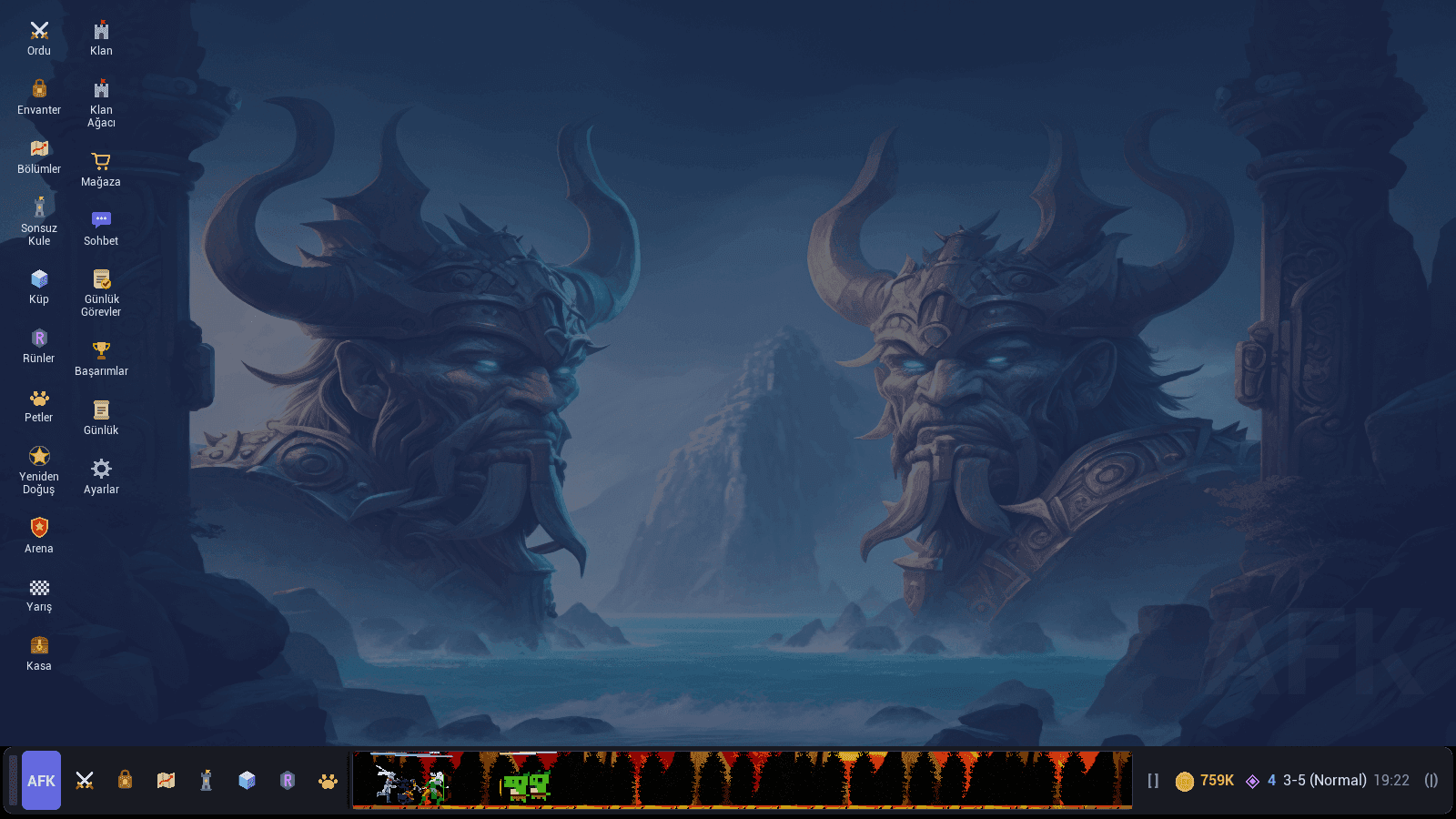
The short description: an idle RPG built as a fake desktop operating system. Your army fights inside the taskbar while you do something else; you open windows, compare gear and plan your next build.
What happens in the taskbar?
The heart of the game is the thin strip at the bottom of the screen. Combat runs there live: your heroes advance, monsters arrive, the wave ends, the next one starts. Click the strip and the fight goes full screen; close it and your army carries on.
This is not an idle game that pesters you with notifications. It asks for no attention, runs in the background, and when you do look, one glance is enough — gold, stones, your current stage and the wave counter all sit in the tray.
Why an operating system?
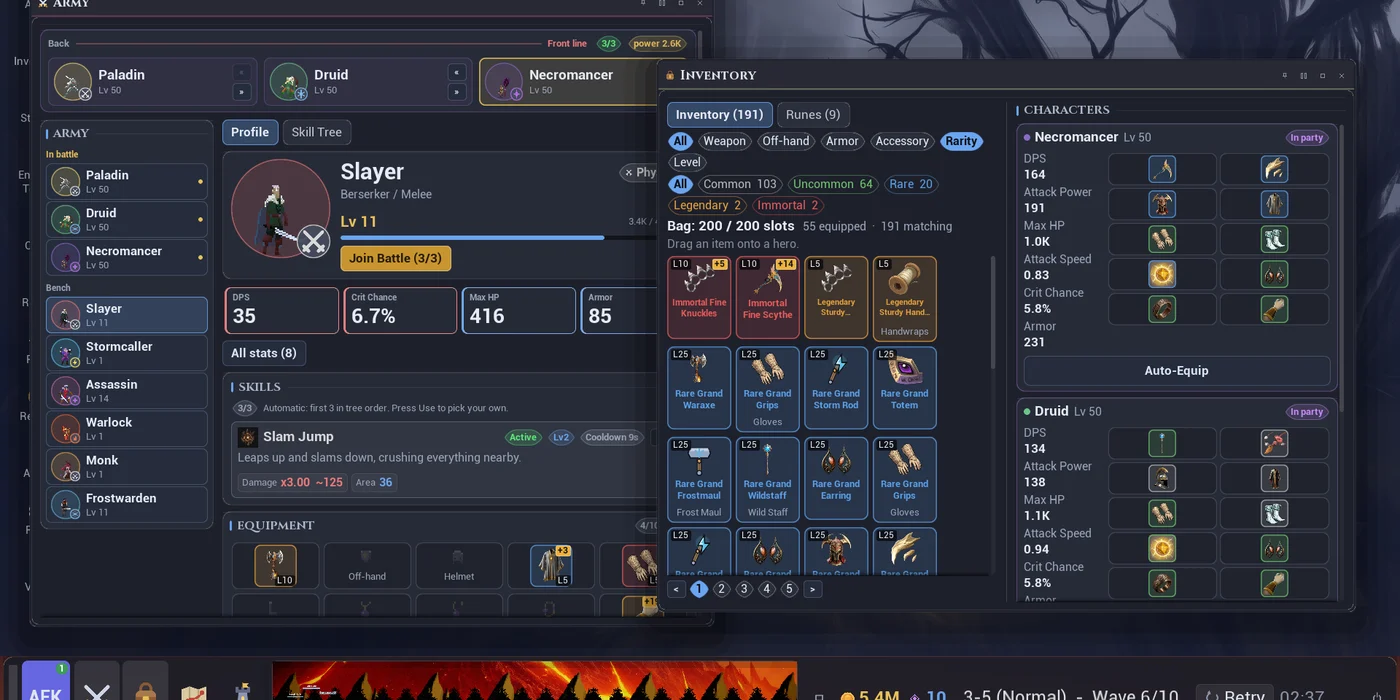
Most idle games are managed through menus on a single screen. We chose the window metaphor instead: Army, Inventory, Cube, Runes, Arena and Clan open as separate windows, sit side by side and can be dragged. While comparing gear you can keep the inventory and the hero profile open at the same time.
There is a design benefit too: a player who knows the game always finds what they need in the same place. The start menu, taskbar buttons and tray borrow an interface language people already learned.
Nine heroes, three on the field
There are nine heroes in the roster; three take the field at once. Ranged heroes stay in the back line, melee holds the front. The rest wait on the bench, keeping their levels and their gear.
What turns team building into a decision is this: weapons, off-hands and elements are locked to a class. Bringing a hero into the roster also decides which gear you will collect and which element you invest in. Five elements form a rock-paper-scissors cycle, so a roster tied to a single element struggles on certain stages.
Every hero has their own skill tree: active skills and passive stat nodes spread across eight tiers that open with hero level. The hero on the field automatically uses the first three actives in tree order — reorder them and you decide the priority.
Loot is a flow, not an event
In an idle game, hundreds of items drop overnight. Reviewing them one by one turns the game into work. Our answer is simple: you write a rule once. Ask me about legendaries, send runes to the Cube, melt the rest.
The pipeline enforces the rule; only exceptions reach you. The decision queue holds at most fifty entries, so your bag never fills up and stalls the game. That design decision is the same thing we often build into business software: exception handling. The system runs the routine itself and brings a human only what actually needs a decision.
Ten quality tiers and real risk
Loot spans ten tiers from Common to Cosmic. A higher tier means more bonus lines and more sockets. Items are enhanced from +0 to +25, and past a certain point failure downgrades the level — so enhancement carries real risk. The game does not hide it: the true success rate for each attempt sits on screen before you confirm.
The Cube sits at the centre of this economy: it melts items, turns runes into gems and gems into runes, and runs crafting recipes. Runes drop carrying three candidate stats and the dice are rolled when you socket them — which is why even a rune for the wrong class is never waste.
Five acts, four difficulties, an endless tower
The world spans five acts with ten stages each. Normal, Nightmare, Hell and Torment unlock in order; each tier hardens the monsters while shifting loot quality upward.
Alongside it there is a tower with no ceiling: every floor has its own element, a four-minute time limit and milestone rewards. The tower is where roster diversity gets tested — a single-element army hits a wall on certain floors.
The arena: asynchronous PvP you can replay
The arena was the most instructive part for us. You send your army; you never wait for an opponent. The server re-simulates the fight with the same deterministic engine the client runs and hands you the replay.
Deterministic means this: the same input always produces the same result. So the outcome can be verified on the server, replayed step by step for the player, and the "it looked different on my side" argument disappears. The same principle serves us when we build calculation engines for clients: fix the inputs and the version, and you can always reproduce the result.
Clans, chat and twelve languages
On the clan side there is a shared progression tree: members contribute, the hall grows, and unlocked boosts apply to everyone. Announcements, applications, chat channels and private messages come with it. The interface runs in twelve languages.
How did we build it?
The engine is framework-free vanilla JavaScript; the desktop package is Electron. Everything about balance — hero stats, monster tables, drop rates, the rune tree, tower scaling — is not buried in code but kept in data files.
That has a visible consequence: the game's wiki is generated from that data. The tables on afk.lumethis.com were not written by hand; when the version changes, the pages change too. Generating documentation from a single source of truth is something we argue for in business software as well — one of the points that matters most in the custom software versus off-the-shelf discussion.
Our development approach matches it: small, measurable steps with a working build at every step. We covered how AI-assisted development fits that discipline in what is vibe coding.
Where can you look?
The game ships as a Windows desktop application and is under active development. A Steam store page is in preparation: it targets Windows 10 64-bit, ships the interface in twelve languages and is configured for single-player and online PvP; we will add the link here once the page goes live. All of the systems — heroes, items, runes, acts, monsters, the tower, the arena, clans — are documented in detail in the wiki. For the project summary, see our project page.
If you need the same discipline while building your own product — getting the data model right from the start, keeping computation reproducible, generating documentation from one source — get in touch or take a look at our services.
Frequently Asked Questions
- What is AFK: Army For Keyboard?
- An idle RPG that runs inside the Windows taskbar. It is built as a fake desktop operating system: sections such as Army, Inventory, Cube and Arena open as separate windows you can use side by side. Combat runs in a thin strip at the bottom of the screen while you do something else; clicking the strip takes the fight full screen.
- Does the game have to stay open all the time?
- No. It asks for no attention: it runs in the background, and progress continues as offline earnings when it is closed. When you do look, one glance is enough — gold, stones, your current stage and the wave counter sit in the taskbar tray. Anything that needs a decision collects in a separate queue according to your loot rules.
- How many heroes are there and how is a roster built?
- There are nine heroes and three take the field at once. Ranged heroes stay in the back line and melee holds the front; the rest wait on the bench and keep their levels. Because weapons, off-hands and elements are locked to a class, choosing a roster also decides which gear you collect. The five elements form a cycle, so a single-element roster struggles on certain stages.
- Where is the wiki and is it up to date?
- The wiki is at afk.lumethis.com. Its tables are not written by hand: hero stats, monster values, drop rates, the rune tree and tower scaling are generated directly from the game's source data files. When the game version changes, the pages change with it, so the wiki carries the same accuracy as the game.
Need help with this topic?
Contact Us